Technology
Postbank Opens Its 600+ Branches and Agents to Kenya's Other Banks: Shared Agent Banking Arrives via Pesalink
November 10, 2026GashoTech Team
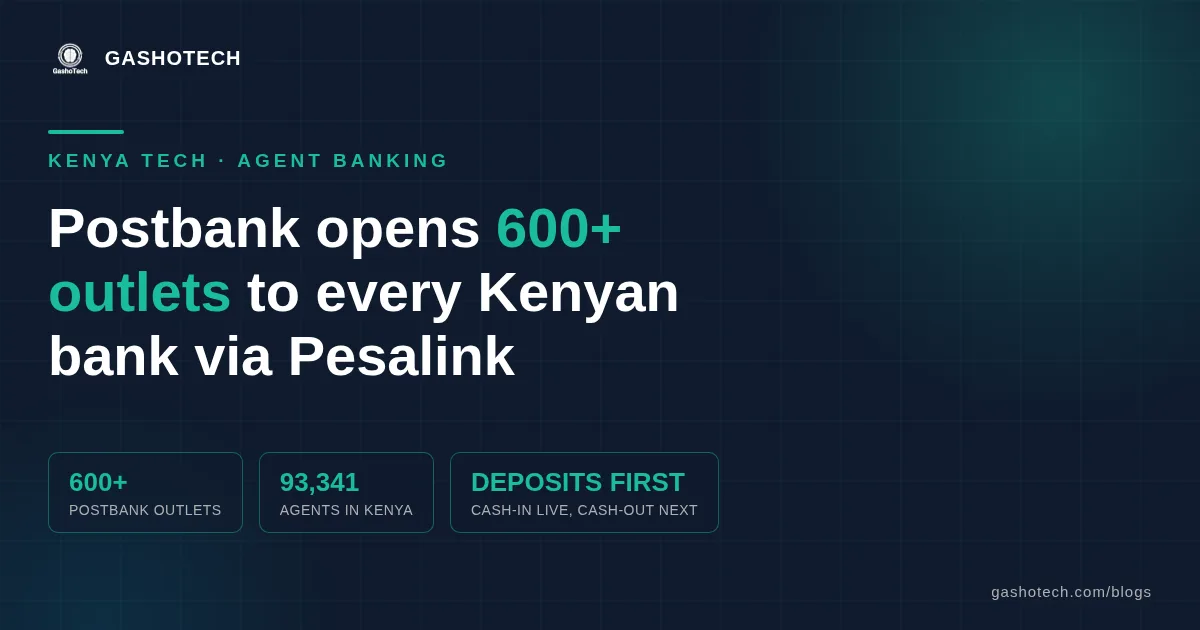
On 4 November 2026, Kenya's payments plumbing gained a shared cash desk. Postbank PLC and Pesalink announced a partnership that lets customers of participating commercial banks and SACCOs deposit money at any of Postbank's more than 600 branches and authorised agent outlets, with the funds credited straight into their own accounts in real time over Pesalink's instant payment rails. No new app. No new card. Just a decision that one bank's physical network is now open infrastructure for other lenders.
Agent banking is how a large share of Kenya actually touches its banks. The Central Bank of Kenya's 2025 bank supervision report counted 93,341 commercial bank agents nationwide, and cash deposits make up nearly half of the transactions those agents record. Digital payments keep growing, but cash still changes hands at the market, the boda stage and the duka, and every one of those notes has to enter the formal system somewhere. Until this week, "somewhere" was mostly an agent of your own bank.
The mechanics are simpler than the press-release language suggests. Postbank's branches and agents already handle cash for Postbank's own customers. Under the partnership, an agent at a participating outlet can also accept cash from a customer of a different bank or SACCO, and Pesalink, the instant payments network operated by Integrated Payment Services Limited (IPSL), routes the deposit to that customer's own institution for real-time credit.
Postbank has served other financial institutions through one-to-one bilateral agreements before. What changes is the shape of the connection: instead of every bank negotiating its own commercial deal and building its own technical integration into Postbank's network, participating institutions plug in once through Pesalink's shared infrastructure. IPSL chief executive Gituku Kirika framed it as the sector's next step: agent banking remains one of the most important ways Kenyans access financial services, and banks and SACCOs can get more value from networks they have already built by opening them to other institutions' customers.
TechTrendsKE, which reported the deal on 4 November, noted that more institutions are expected to join in the coming months. That list matters more than the announcement itself, because a shared counter only helps you once your bank is on it.
Three figures give the story its weight.
Six hundred. That is the number of Postbank branches and authorised agent locations the partners say are now open to visiting customers. Postbank is Kenya's state-owned savings bank, established in 1978 and wholly owned by the government, and its leadership describes it as the pioneer of agent banking in Kenya, a claim worth reading as institutional pride rather than independent history. What is not in dispute is the footprint: Postbank outlets sit in county headquarters and market towns where commercial bank branches thin out.
Ninety-three thousand. That is the CBK's count of commercial bank agents in Kenya from its 2025 supervision report. It sounds like abundance until you look at who owns the network: per tech-ish coverage of that report, Equity, KCB and Co-operative Bank together contracted more than 85% of those agents. If your bank is not one of the big three, your physical access map is dramatically sparser than the national average suggests.
Half. Cash deposits make up nearly half of recorded agent transactions, per the same CBK data. Kenya's digital rails are world-class on paper, but the entry point for physical money is still a human behind a counter. Deposit reach is not a nice-to-have; it is the front door of the banking system.
The economics here are the real story. A bank branch is expensive to build and slow to place; an agent is a shop that already exists. Kenya's mobile money operators proved the model at national scale: the M-PESA agent network became, in effect, a cash desk for the whole economy, serving anyone with a phone line regardless of which network they called home. Bank agents never worked that way. They served their own institution's customers, and every attempt to share them required bespoke bilateral deals that only the largest lenders had the leverage to arrange.
Opening one network through a shared switch inverts that logic. A SACCO with two branches and no agent network can suddenly offer members hundreds of deposit points without building anything. A mid-tier bank can extend its cash-in reach overnight. And Postbank, which holds under-used state infrastructure and a financial-inclusion mandate, turns idle counter capacity into transaction revenue. Nobody has to build a new network; the existing one just gets permission to serve more people.
This is also the direction Kenya's payment regulation has been pushing. The draft National Payment System Bill and policy placed before the public in September 2026 centre interoperability and shared infrastructure across the payments market. A bank network opening through Pesalink is that policy instinct arriving in practice, ahead of the statute.
If you bank with one of the large lenders, little changes today; you already have agents on most corners. The story is for everyone else: SACCO members, customers of smaller banks, and Kenyans in towns where the nearest branch is a matatu ride away. Once your institution joins the arrangement, the Postbank agent at your market becomes your deposit window, and the money lands in your account in real time.
Three practical rules before you queue. First, confirm your bank or SACCO has actually joined; the arrangement serves participating institutions, and the launch coverage does not yet name which lenders are live. Second, this phase is deposits only, so withdrawals still run through your own bank's channels, while Postbank customers keep their full services exactly as before. Third, ask what a deposit costs before you hand over cash; the partners have not published a public fee schedule in the launch coverage, and a shared counter is only cheaper than a matatu ride if the fee says so. And as with any agent transaction, deal only with genuine authorised outlets, and never share your PIN with anyone behind the counter.
Three things will tell you whether this becomes infrastructure or stays a press release. The participating list: which commercial banks and SACCOs actually onboard in the coming months, and how fast. The withdrawal phase: deposits are the easy half; the day a Postbank agent can hand out cash against another bank's account, the network becomes a true shared branch. The price: interoperable rails only matter to a household if the deposit fee beats the bus fare it replaces.
Kenya's fintech story is usually told as apps and APIs, but the country's most decisive infrastructure is physical: agents, counters, and the trust of the person who runs the shop. Postbank and Pesalink just turned one state-owned network into a national cash-in utility for any lender willing to plug in. If three banks controlling 85% of 93,341 agents is the problem, shared counters are the cheapest answer anyone has proposed yet. Watch the participating list, not the headline.
Agent banking is how a large share of Kenya actually touches its banks. The Central Bank of Kenya's 2025 bank supervision report counted 93,341 commercial bank agents nationwide, and cash deposits make up nearly half of the transactions those agents record. Digital payments keep growing, but cash still changes hands at the market, the boda stage and the duka, and every one of those notes has to enter the formal system somewhere. Until this week, "somewhere" was mostly an agent of your own bank.
What the deal actually does
The mechanics are simpler than the press-release language suggests. Postbank's branches and agents already handle cash for Postbank's own customers. Under the partnership, an agent at a participating outlet can also accept cash from a customer of a different bank or SACCO, and Pesalink, the instant payments network operated by Integrated Payment Services Limited (IPSL), routes the deposit to that customer's own institution for real-time credit.
Postbank has served other financial institutions through one-to-one bilateral agreements before. What changes is the shape of the connection: instead of every bank negotiating its own commercial deal and building its own technical integration into Postbank's network, participating institutions plug in once through Pesalink's shared infrastructure. IPSL chief executive Gituku Kirika framed it as the sector's next step: agent banking remains one of the most important ways Kenyans access financial services, and banks and SACCOs can get more value from networks they have already built by opening them to other institutions' customers.
TechTrendsKE, which reported the deal on 4 November, noted that more institutions are expected to join in the coming months. That list matters more than the announcement itself, because a shared counter only helps you once your bank is on it.
The numbers behind the counter
Three figures give the story its weight.
Six hundred. That is the number of Postbank branches and authorised agent locations the partners say are now open to visiting customers. Postbank is Kenya's state-owned savings bank, established in 1978 and wholly owned by the government, and its leadership describes it as the pioneer of agent banking in Kenya, a claim worth reading as institutional pride rather than independent history. What is not in dispute is the footprint: Postbank outlets sit in county headquarters and market towns where commercial bank branches thin out.
Ninety-three thousand. That is the CBK's count of commercial bank agents in Kenya from its 2025 supervision report. It sounds like abundance until you look at who owns the network: per tech-ish coverage of that report, Equity, KCB and Co-operative Bank together contracted more than 85% of those agents. If your bank is not one of the big three, your physical access map is dramatically sparser than the national average suggests.
Half. Cash deposits make up nearly half of recorded agent transactions, per the same CBK data. Kenya's digital rails are world-class on paper, but the entry point for physical money is still a human behind a counter. Deposit reach is not a nice-to-have; it is the front door of the banking system.
Why shared beats one-to-one
The economics here are the real story. A bank branch is expensive to build and slow to place; an agent is a shop that already exists. Kenya's mobile money operators proved the model at national scale: the M-PESA agent network became, in effect, a cash desk for the whole economy, serving anyone with a phone line regardless of which network they called home. Bank agents never worked that way. They served their own institution's customers, and every attempt to share them required bespoke bilateral deals that only the largest lenders had the leverage to arrange.
Opening one network through a shared switch inverts that logic. A SACCO with two branches and no agent network can suddenly offer members hundreds of deposit points without building anything. A mid-tier bank can extend its cash-in reach overnight. And Postbank, which holds under-used state infrastructure and a financial-inclusion mandate, turns idle counter capacity into transaction revenue. Nobody has to build a new network; the existing one just gets permission to serve more people.
This is also the direction Kenya's payment regulation has been pushing. The draft National Payment System Bill and policy placed before the public in September 2026 centre interoperability and shared infrastructure across the payments market. A bank network opening through Pesalink is that policy instinct arriving in practice, ahead of the statute.
What it means for your market day
If you bank with one of the large lenders, little changes today; you already have agents on most corners. The story is for everyone else: SACCO members, customers of smaller banks, and Kenyans in towns where the nearest branch is a matatu ride away. Once your institution joins the arrangement, the Postbank agent at your market becomes your deposit window, and the money lands in your account in real time.
Three practical rules before you queue. First, confirm your bank or SACCO has actually joined; the arrangement serves participating institutions, and the launch coverage does not yet name which lenders are live. Second, this phase is deposits only, so withdrawals still run through your own bank's channels, while Postbank customers keep their full services exactly as before. Third, ask what a deposit costs before you hand over cash; the partners have not published a public fee schedule in the launch coverage, and a shared counter is only cheaper than a matatu ride if the fee says so. And as with any agent transaction, deal only with genuine authorised outlets, and never share your PIN with anyone behind the counter.
What to watch next
Three things will tell you whether this becomes infrastructure or stays a press release. The participating list: which commercial banks and SACCOs actually onboard in the coming months, and how fast. The withdrawal phase: deposits are the easy half; the day a Postbank agent can hand out cash against another bank's account, the network becomes a true shared branch. The price: interoperable rails only matter to a household if the deposit fee beats the bus fare it replaces.
The GashoTech take
Kenya's fintech story is usually told as apps and APIs, but the country's most decisive infrastructure is physical: agents, counters, and the trust of the person who runs the shop. Postbank and Pesalink just turned one state-owned network into a national cash-in utility for any lender willing to plug in. If three banks controlling 85% of 93,341 agents is the problem, shared counters are the cheapest answer anyone has proposed yet. Watch the participating list, not the headline.
Want to learn more?
Contact GashoTech for personalized consultations on AI, automation, and cybersecurity solutions.
Get in Touch